

For Ed Desmond, the phrase “never worry alone” is more than a motto; it’s the foundation of how Mental Health America of Ohio’s Family Advocate Program approaches caregivers.
Caregivers supporting a loved one living with a severe and persistent mental illness (SPMI) often shoulder immense responsibility while navigating complex systems, emotional strain and uncertainty, yet their needs are frequently overlooked.
The Family Advocate Program, funded by the Alcohol, Drug and Mental Health Board of Franklin County (ADAMH), was built to provide one-on-one peer support for those caregivers.
Ed recognized the need for a service like this early in his career. For nearly 37 years, Ed was the director of the Community Support Network out of Twin Valley Behavioral Healthcare, now Central Ohio Behavioral Healthcare. During his time working with inpatient and outpatient clients, he came across many families who didn’t know how to approach their loved one’s diagnosis.
“They didn't understand what was going on or how to even communicate with their mentally ill family members,” Ed shared. “So, I identified that as a gap in services. When I retired I thought I’d try and fill that gap. I worked with ADAMH and Mental Health America of Ohio and they were so gracious to help me set up the program.”
Launched in 2019, program activities now include in-person and phone-based peer support, advocacy and assistance navigating provider and public benefits systems. In addition to Ed, the program has a team of program volunteers, referred to as family advocates, who help caregivers understand their emotional responses, as well as build skills in self-care, boundary setting and conflict resolution. Guidance is also given on involuntary hospitalization, probate and the Franklin County Probate Court guardianship process.
Learning to navigate the unknown
Since launching the program, Ed has supported more than 200 families, including Joan, whom he first connected with in 2020 when her son, Matt, who lives with bipolar disorder with psychotic features, was experiencing a significant crisis.
Throughout Matt’s childhood, Joan said she and her son were very close. He was energetic, compassionate and funny. But late in his teenage years, she noticed a dramatic change in his behavior.
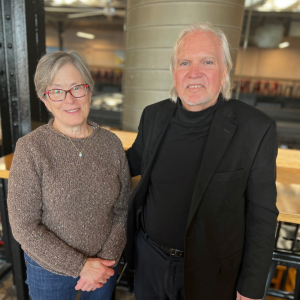
“All of a sudden he was very angry and disgusted by me,” Joan said. “He was unrecognizable. We were hopeless and had no idea what to do or how to help him, but then my husband and I connected with Ed.”
In those first few months, Joan and Ed spent hours on the phone. Ed helped her better understand how Matt’s diagnosis was influencing his decisions, guided Joan in processing the hurt when those choices felt negative toward her, and supported her in finding constructive ways to rebuild and strengthen their relationship.
“While Ed didn’t change the situation, our conversations put a frame around Matt’s diagnosis and gave it a definition,” Joan said. “Ed never gave me false hope, just what it takes to continue with a reasonable attitude.”
With Ed’s support through the Family Advocate Program, Joan’s relationship with her son has steadily improved, as has her commitment to self-care. Through their conversations, she’s learned to recognize when she needs a break so she can return more grounded and better equipped as a caregiver.
Ed hopes Joan will one day become a trained volunteer with the program, using her lived experience to support other caregivers navigating similar challenges and carrying forward the meaningful work he has dedicated much of his life to.
“This has truly been a calling for me,” Ed shared. “I think it’s a wonderful program and I’ve always dreamed of having this kind of impact, which is why I still feel like what I’m doing is worth it.”
For Joan, that sense of calling has made a lasting difference.
“Ed has been so supportive,” Joan said. “Throughout the years, I need to know who I can talk to when I’m frustrated and how to deal with my own emotions, which is why I still talk with Ed. He is what keeps me from giving up.”
Anyone can access the Family Advocate Program or inquire about becoming a volunteer by calling by calling 614-242-4357 or sending an email to the program at Connect@MHAOhio.org.